A step-by-step guide to create and implement a performance pay employee incentive program that works for home service contractors.
You have probably heard through channels, speakers and books about performance-based pay systems and how they will revolutionize your business. How they will drive better results with your field staff, foremen or technicians. The only problem is no one tells you how to implement one! Many times, it is a mixture of trial, error, more trial and eventually back to the old way. Don't worry, I was there with my own business. With over 82 install employees and for over 15 years, we mixed, matched and misfired on understanding, implementing and driving performance incentive plans.
What Is Performance Pay?
Before we break down this topic, let's first understand what performance pay is for companies like ours. Performance pay is an employee incentive program that rewards the behaviors that drive profit. Yep. It is that simple, and that's the key to performance pay systems. Blog over, right!? Not quite, but buckle up, we will have some fun here. (If you want the deeper background, start with what pay for performance in the trades is and how to implement it.)
The KISS (Keep It Simple Stupid) method is a real thing. I can't tell you how many times I have met with owners that are really overcomplicating this simple and proven system. If it takes more than a few sentences to explain, you are toast. Secondly, if you are piling money onto actions that are not driving results, then you are just pushing out profits. Spiffs, spot bonuses and other cash incentives are only encouraged when the largest expense in your company (labor) is put in check. Then you can have some fun, be creative and design some other bonus systems. Let's first fix the problem (labor), then we can drive even more productivity with the other items.
The 3 Steps to an Employee Incentive Program That Works
In this guide I will plainly explain the best way to implement a performance-based pay incentive program. It falls into three separate areas:
- Understand where your labor is now. If you are trying to improve this, best to know where you are now. If you don't, no worries – we help companies daily with this.
- Set a specific target that an employee can understand, in real time, and then support them in hitting it. In the famous words of Zig Ziglar: "You will never hit a target you don't have." Your employees don't know what you want, so they will default to: more hours equals more take-home pay. Meanwhile it is killing your profits.
- Set clear expectations on what winning and losing look like. You will have team members that move mountains to get the best for their teams, their families and their paychecks. Others will stumble. Be ready for this and know when to adjust and continue pushing forward.
So knowing these three simple (not easy) steps, let's take a dive into how to implement. If you can execute, you will be one of the many that have seen on average: a 12% increase in install rates, a 3% labor drop and lastly, my favorite, giving your employees a raise so they can support their families!
Step 1: Understand Your Existing Labor
One thing about performance incentives: they are not a money tree. They must have a direct result on lowering your labor costs, job overruns, etc. If you don't know what this is, then we should understand it. Take your total labor for your field team (not managers, unless they were physically in the field installing). Take this number and divide it by your total invoiced income for a month. This will very clearly give you a number that should match your profit and loss statement.
Labor % = Total field labor ÷ Total invoiced income (for the month)
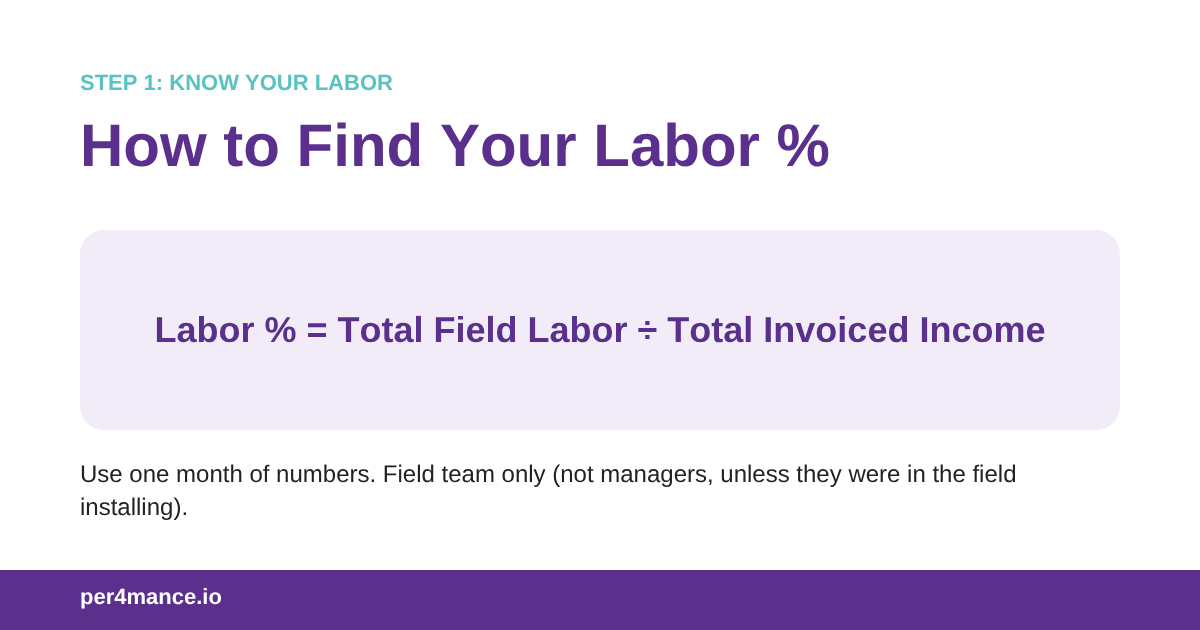
When observing this number, many folks come up with a few questions. Questions like: How do I know if this is good or bad? Is this something that can be improved? How did we arrive at this number?
Most of this number is made up of a few actions, like how you sell and how you manage the calendar. If you were to schedule more, you would see this naturally turn downward. However, with regulation, OVERTIME becomes a margin killer. So it is not just a simple "Install more!" answer. When you have clearly identified your labor, then we can help compare to see what is possible. I recently did this with a general contractor that didn't know if his labor was high or low. After some research, he was nearly double what others in his industry had! He was glad to know despite the number, because now he can take action and drive more profits to the bottom line. (This is exactly where construction labor tracking software earns its keep.)
Step 2: Set Specific Targets

Now that you know where your labor is and where it can be, let's start setting a target. Maybe you bid your jobs by square ft, linear ft or budgeted hours. Either way, we need to determine the specific threshold where your labor goes over your allocated budget. This is commonly revealed in jobs going over deadline, overstaffing on jobs and complete budgets blown by overtime.
So when you bid your job, you likely have some method that determines how much labor to account for. This could be an educated guess, budgeted man-hours, target labor as margin and so on. If you are just taking a good guess, that's not ideal, but we have all been there. But when you set that number down on a contract and the customer signs, it is typically intended for you to be left with profit. As contractors, you don't play to lose. Performance pay is a great method to make sure that you are getting the absolute best out of your labor budget, and that it is clearly in the hands of the ones executing it.
If you hide a performance pay bonus in a three-digit metric or "KPI," then the employee doesn't have direct access to it. For example: if you have performance pay for material overruns on a job, but they are not solely responsible for ordering and delivering those materials, they are several degrees separated from control. A solid performance pay incentive program clearly outlines a way to execute based on what the front line can control: THEIR TIME!
This can be measured in several ways. We see spray foam companies use square ft or board ft as a target. You get $X per board ft. If it takes you two days, great… knock it out in one and it is still the same. Many companies elect to show them the % of revenue allocated specifically for that piece of the job. This gives a clear number for anyone on the team to aim at. In all these examples the main message is clear: Here is the target. Beat it and get paid more. SIMPLE.
When you start throwing escalators and other items on top of it to qualify, the employee feels like the game is rigged. Here is the target, hit it or beat it. The best part of this model is quality control. If they mess it up, then the return trip comes out of their share. SIMPLE. There are ways to automate this for compliance, to make sure that this is not simple piece rate, which we don't recommend for Department of Labor compliance.
Step 3: Set Clear Expectations
The last one is about leadership and making sure that there are clear expectations for your team. This is important because you want to be clear that this is not just money given away. The hard part for some young or soft leaders is not bending the rules because the guys worked hard and they need an attaboy. Attaboys are spiffs or spot bonuses, not performance-based pay. And they do not change behavior. Here are some common expectations we recommend and see numerous companies use in their performance-based pay plans across the country:
- Collection of the project or phase of the job
- Pictures uploaded into your field management application or CRM
- Materials used on the jobs for job costing
- Receipts of any one-off purchases
- Driver safety/time logs
- Customer sign-offs or authorizations
- Delivery of a review link
- Tool/truck safety checklists
- Tardiness or absenteeism threshold
I don't recommend all of these, but I find holding performance pay for the ones that most affect your profit and cash is best. For example: collection of the job, materials and pictures. Another area to be very clear on is a defined callback window. In all of my years in my business, I have never had a crazy customer… just kidding (enjoy my real-world humor). We have a 6-month window: if we have to go back for whatever reason, that comes out of future bonuses to ensure good quality work.
This firm but fair approach will create a workplace culture where your teams are running jobs like they own their own miniature business. One without all of the headache of actually running the business. (More on that in 5 ways to build company culture.) And when your crews start winning, celebrate them, like we do with our Top Foremen every month.
So to Recap
A performance pay employee incentive program comes down to three steps:
- Know your labor rates and where they can be.
- Set clear targets that give opportunity for the team and opportunity for labor reduction.
- Set clear expectations of what allows performance pay to be given, held or pulled back.
This is something I work on with contractors every day, and I love it. If you want help setting up performance pay for your crews, my teammates and I are here. Just know you are not alone.
Want to learn more? Book a demo and see how it works for your crews.
Book a Demo
Frequently Asked Questions
What is an employee incentive program for contractors?
It is a pay plan that rewards your field team for the behaviors that drive profit. For contractors, that means beating the labor budget on a job while keeping the quality high. Hit or beat the target, get paid more.
Why don't hourly bonuses or spiffs change crew behavior?
Because they are not tied to a target the crew controls. Spot bonuses and attaboys feel good, but they don't fix labor. And without a target, your guys will default to more hours equals more take-home pay.
How do I calculate my labor percentage?
Take your total field labor for the month and divide it by your total invoiced income for the same month. It should line up with your profit and loss statement.
What should a performance pay target be based on?
Something the front line controls: their time. That can be square ft, linear ft, board ft, budgeted hours or the % of revenue set aside for labor on that piece of the job.
What happens to the bonus if a job needs a callback?
Set a defined callback window. We use 6 months. If we have to go back, that return trip comes out of future bonuses, which keeps quality where it should be.